Search

» » Oscar Wilde (1960)

Short summary

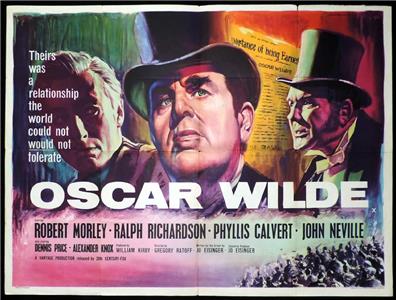
In the 1890s, famed writer Oscar Wilde (Robert Morley) embarks on a relationship with Lord Alfred Douglas (John Neville), despite his marriage to Constance (Phyllis Calvert). This relationship and its consequences are the focus of this dramatization of Wilde's life. Wilde sues Alfred's father, the Marquis of Queensberry (Edward Chapman), for libel - a lawsuit that turns against him when a prosecuting lawyer forces him to admit to his homosexuality, leading to a second lawsuit.

Robert Morley made his name on the stage playing Oscar Wilde at the London Gate Theatre in 1936. The play was a success despite being banned from major London theatres because of its theme of homosexuality, and was later produced in America with Morely making his Broadway debut in the part on October 10, 1938. The play was a hit in New York City and ran for two hundred forty-seven performances, a substantial run at the time for a straight play.

This was the more modest of the two biopics of Oscar Wilde which opened in Britain, where both were made, in 1960. The two films were announced by rival companies within a few days of each other, began filming almost simultaneously, and were released in cinemas only a few days apart. This black-and-white, low-budget version made it onto the screen first, but was dismissed by most critics, and failed at the box-office. The other movie, The Trials Of Oscar Wilde (1960), was lavishly produced in Technicolor and Technirama and featured a star-studded cast led by Peter Finch as Wilde. It got rave reviews, but it, too, failed financially.

Robert Morley told a biographer in his old age that when he had first played Oscar Wilde in 1936, he had been too young for the part, and that when he played him again in this movie, he had been too old.

User reviews


  • comment
    • Author: Fhois
    Whatever money was spent on this movie certainly didn't go on the sets, the furniture looks as though it was assembled by a local handyman and the trial scenes, which make up the largest part of the film, seem to be taking place in a converted church hall or school gymnasium with hastily constructed props. However this happens to be a very good film indeed, the superb acting carries the film and makes it far better than the more lavish Peter Finch version which was released about the same time.

    I've always thought of Robert Morley as just a comic character playing himself but here he really becomes Oscar Wilde. You can imagine Wilde talking and behaving as he does in this movie . The verbal exchanges between Morley as Wilde and Ralph Richardson as the prosecutor are magnificent. Wilde enjoying the limelight, plays to the gallery and wins every one of the exchanges until he gets too confident, makes one fatal error and then the prosecutor starts to chip away at his defense.

    The minor characters are uniformly well acted with Phyllis Calvert as Wilde's wife, Dennis Price as his loyal friend and Edward Chapman as the boorish Marquis of Queensbury . John Neville is probably a little too old to play Sir Alfred Douglas but his skilful acting makes it work . The final scenes between Wilde and his family are very touching.

    Well worth seeing.
  • comment
    • Author: Rocky Basilisk
    Unlike the stiff and flashy Peter Finch film released a year later,this film is a gem. Robert Morely more than captures the wit,pain and humanity of Oscar Wilde. The film is very daring for its time,not only by presenting Wilde's trials for Gross Indecency on film,but for its loving and sympathetic portrayal of the man.

    John Neville is also wonderful as Bosie Douglass,Wilde's lover,and Sir Ralph Richardson as Edward Carson illuminates the trial scenes. The interrogation of Morley by Richardson,and Morley's witty comebacks are not only tyhe highlight of the film,but possibly could be one of filmdom's greatest trial scenes.

    Where the Finch film glossed over the surface of the events,this film takes you into the real people involved,Phyliss Calvert as Wilde's Wife,Constance and Dennis Price as his friend Robbie Ross are also wonderful in their role. Its a shame this film is not yet available on video for all to cherish.
  • comment
    • Author: Ariurin
    Oscar Wilde reputation is set for all time. He was a brilliant, witty writer of graceful style. He was also a bi-sexual, whose affair with Lord Alfred Douglas led to a tragic final fall when exposed in court. What most people forget is that the trial where he was exposed was a libel suit against Lord Alfred's brutal and mad father the Marquess of Queensbury (the one who gave us the rules for boxing). Queensbury hated his sons and their mother, and his antics helped lead to the suicide of one of the sons (the private secretary of Prime Minister, Lord Roseberry). Queensbury disliked Wilde for his influence over Lord Alfred and his unspeakable homosexual affair with his son. He sent him a note on a card, "To Oscar Wilde, disguised as a "somdomite"." The Marquess presumed that by misspelling sodomite he was protecting himself but smearing Wilde. Wilde had an opportunity then to ignore the slur and go abroad for awhile (which most men in his position would have done). He decided to sue - goaded into it by Lord Alfred (who saw this as a safe opportunity to hit at his father). Never has such a critically important legal decision been made on such a stupid basis.

    The barrister for Queensbury was Edward Carson, one of England's greatest lawyers. He is the model for the barrister played by Robert Donat in "The Winslow Boy" (based on Carson's defense of young Archer-Shee in the 1911 legal action). Carson was a master of cross-examination, and he had plenty of information that Queensbury (and Wilde's many enemies) had gathered about his sexual activities. But Wilde was able to fend off the attack for hours, until he reached a series of questions about a telegraph boy who was available for sex for hire. Carson had been unable to make a dent into Wilde's hide so far, and then out of sheer desperation asked, "Did you kiss him?" Wilde was amazed - the question did throw him. "Did I kiss him?", he repeated. "Yes", answered Carson with a lack of real interest. Wilde had been trumping Carson with one-liners that left the court in stitches. Instead of saying, "Of course not!" or "How dare you!", which would have helped, Wilde quipped the sentence in the summary line above. And Carson saw the light at the end of the tunnel. Wilde never recovered after that.

    The jury was able to absolve Queensbury of libel (after all, it was shown that Wilde was homosexual). The authorities now held back for nearly twelve hours from going after Wilde. They simply hoped he would flee to the continent. Instead, Wilde decided to stay and fight. It is the second trial that really demolished him. He was now on trial of committing sodomy, and the evidence was too overwhelming. Found guilty, he was sentenced to three years in prison. He left prison and lived in France until he died in Paris, a broken, impoverished wreck, in 1900.

    If you are a homosexual, Wilde is one of the great martyr's to the cause. If you love good writing his end is a dismal tragedy. All the films of his life retell it's denouement. It never gets any better in the retelling - there is no repaired last act. Even (historically) a "reformed", right-wing supporting Lord Alfred rejected the image of his "Bosie" period in later years - claiming he never was a homosexual. One ends just pitying Wilde, unless one is just a reactionary type or a mindless idiot like Queensbury.

    Robert Morley never gave a better dramatic performance on film (as opposed to his comic performances) than in this film. Witness his moment on the witness stand, when he realizes the result of his blunder. The cast of John Neville, Ralph Richardson, Edward Chapman, and Dennis Price do equally well in this tale of talent that was shot down so stupidly. I certainly recommend watching it...and then reading "Dorian Gray", "The Importance of Being Earnest", "Salome", "The Ballad of the Reading Gaol", to get a glimmer of the talent that was smashed beyond repair.
  • comment
    • Author: Leyl
    Without a doubt, this is the film to see if you are deeply interested in this unconventional and fabulous writer that was Oscar Wilde. Two other films about him were shot: "the Trials of Oscar Wilde" and Brian Gilbert's work in 1997 but they aren't found wanting to Gregory Ratoff's version.

    Of course, it's indisputable that Ratoff's film was made with restricted means as the cheap scenery testify. It sometimes gives way to drawbacks like in the very last sequence which shows Wilde after his lost trial sitting at the terrace of a Parisian café and next to him, one can hear a musician playing the accordion. A perfect cliché about France. But it's minor quibble and anyway, given the means Ratoff had at his disposal, was there another way to show the audience that Wilde was in Paris under the pseudonym of Sébastien Melmott? Anyway, one can eminently forget the scenery and admire how Ratoff conceived his film. First, he eschewed many traps of the biopic film including the following one: to relate all Wilde's life from his childhood. He chose to steer his film on the period of his life which began with the relationship Wilde developed with his young protégé Lord Alfred Douglas. In a nutshell, this scandalous love (for the time) was the beginning of the end for the witty writer who fell foul of the chic, posh Victorian society. As everyone knows, homosexuality was banned in this very conservative, ossified society and it could only end up as a trial for Wilde. A trial he could only lose but during which he showed a stalwart courage thanks to his own witty answers. This trial is the pinnacle of the film and Ratoff succeeds in incorporating elements of Wilde's anterior life like the introduction at the outset of his wondrous novel "the Picture of Dorian Gray" (1889). And one can only admire his style to film the evolution of this trial and the verbal exchanges between Wilde and sir Edward Carson. At first, Wilde seems sure of himself and his cues make the audience laugh but bit by bit confidence leaves him as he is dwarfed by dogged Carson's ruthless questions. In the long run, Ratoff weaves a stifling atmosphere and it's impossible not to feel it.

    All you have to do is to sit and admire the quality of the dialogs and also of the actors. Robert Morley confers to his main character the wit and wisdom which made Wilde famous. And Ralph Richardson equally delivers a prime performance. But John Neville seems too old for the role Lord Alfred Douglas. In the most recent version, Jude Law was a better choice thanks to his relatively young age.

    Of course, this film will never supersede a good book about one of the most crucial writers who existed on this planet but Ratoff's work makes him justice.
  • comment
    • Author: Marilore
    It took over two decades for Robert Morley to bring Oscar Wilde to the screen. Morley scored his first big break playing Oscar Wilde in what might be described as an off Drury Lane theater because homosexuality was the love that dare not speak its name in 1936. In 1960 in America it was still not spoken though in the United Kingdom it was starting to get a whisper or two.

    One of the great men of literature was brought down by Victorian mores and justice when he happened to run afoul of a monstrously homophobic father who accused him of seducing his son.

    The movie-going public had a double dose of Oscar Wilde in 1960 with Peter Finch giving an equally brilliant performance as Wilde in another film which is seen a lot more often because the producer had the foresight to do it in color. So Morley's feature kind of took a back seat.

    Both films concentrate totally on the trial, the first one for libel that Wilde stupidly brought against the Marquis of Queensbury, father of his inamorata Lord Alfred Douglas. Douglas is played by young John Neville and he's a weak callow youth. I thought Neville's interpretation of the part lacking the bite that John Fraser's had in the Finch film or of Jude Law in the 1997 film Wilde which starred Stephen Fry.

    In the Citadel Film series book on the Films of James Mason, Mason himself said that he liked what Ralph Richardson did with the part of Edward Carson better than his own performance. Richardson could easily have been labeled the shark of Old Bailey. He is devastatingly brilliant in his performance. Mason's words were extremely generous to a colleague he obviously respected and admired. Mason was Carson in the Peter Finch film and he was pretty good himself.

    Phyllis Calvert was the long suffering Mrs. Wilde with whom Oscar had two sons. Poor Wilde was born a hundred years too soon. Today he'd be Ian McKellan and proudly marry Lord Alfred Douglas for better or worse, richer or poorer. Given Bosy's habits it would have been poorer very soon.

    Robert Morley was a great actor who could play a great range of parts from comic to tragic. We're fortunate indeed to have his breakthrough performance preserved
  • comment
    • Author: NI_Rak
    The other comment describes Sir Edward Carson as the prosecutor of Oscar Wilde. That's incorrect.

    What happened was that, in a fit of madness, Oscar Wilde sued the Marquis of Queensbury (the father of his lover, Sir Alfred Douglas and the author of the rules of modern boxing) for slander, based on an accusation by Queensbury that Wilde was a 'somdomite' (sic). All of Wilde's friends tried to talk him out of it - Victorian England worked on a 'don't ask, don't tell' basis, and Wilde was quite safe had he done nothing. But his success as a playwright emboldened him, and he filed suit.

    Carson was retained by the Marquis to defend him. The famous cross-examination occurred during the trial of Wilde's slander complaint. He was destroyed on cross examination, in such a way that the nature of his lifestyle became too public to be ignored. Carson, after he had won the slander case, actually tried to dissuade the Crown from prosecuting, but to no avail. A criminal prosecution did follow, in which Carson was not involved, ending in Wilde's conviction, and a 2 year prison sentence that effectively ended his career and life.

    Carson, an Irish Protestant, earned my own condemnation for his role in opposing Irish independence. But in the Wilde case, he was responding for the defense, and he took active steps thereafter to prevent a prosecution. Wilde was the principal cause of his own legal destruction.
  • comment
    • Author: Freighton
    Across the decades, cinematic directors have sought to discover the essence of the noted 18th century humorous, poet and playwright Oscar Wilde. Some films shower him with so many accolades, they drown his image in wine and sexual innuendos. Other movies hardly delve into the magical but certainly secret complexity of the talented English writer, using his notorious trial, tribulations and eventual imprisonment as Gris, reducing him to a mere scandalous shell of his life. Perhaps, there are many film versions of Mr. Wilde, but only one stands out which personifies the ideal man. I believe this offering, "Oscar Wilde," (1960) portrayed by enormously talented Robert Morley as the playwright, is the best. True Mr. Morley is such a versatile actor in other films, some would suggest his comic side, or his stuffy, droll demeanor, detract from this impressive writer. I disagree. Despite his inner personal conflicts, Morley exemplifies the quick wit, delightful charm and social elegance befitting the true character of the 18th century cosmopolitan gentleman. Moreley more than adequately depicts the larger than life of Oscar Wilde. Ralph Richardson, plays, Sir Edward Carson the prosecuting attorney who's sole ambition was to destroy the popular writer and his libertine attitudes. Although seeking to protect the upper-class from scandal, his attack was nothing short of evisceral. As one newspaper noted at the trial, the prosecutor was seen to be as objective as a circling shark. All in all, this film is an excellent attempt at epitomizing the historical icon, and is accepted as the very best to-date. ****
  • comment
    • Author: Vetalol
    Yes I enjoyed this 1960 biopic but considered the ending too abrupt.To give the film more verisimilitude I would have liked the producer to show Oscar at "hard labour" which involved pointless physical activities given to prisoners who were so sentenced.Robert Morley looked his same rotund self when he came out of Reading gaol after his two years of "hard labour" losing weight as he had not five minutes before looked when he started his sentence!Also I missed the writing of his "Ballad of Reading Gaol" which he wrote when the prison authorities restored his writing materials to him in his cell.

    Peter Finch,Peter Egan and Stephen Fry to my knowledge have also played this great literary figure & wit since the production date of this 1960 version and I accorded it 6/10.
  • comment
    • Author: Tyler Is Not Here
    "he is too old, too fat, unconvincing, far by the character." but he did a great job. in a modest film, start point for discover the fascinating personality of Oscar Wilde. sure, it is far to be the perfect film. but, in its case, the good intentions are more than consolation. in few scenes, Robert Morley is great to amazing. the status of sketch of film is, in part, the consequence of the period context. but the message sounds clear. in essence, the basic sin remains the clash between the perspective of viewer and the images of director. nothing new. the result - after its end, Robert Morley Oacar Wilde is a decent work and beautiful homage to a fascinating name from the fall of XIX century.
  • comment
    • Author: Dikus
    I am a fan of both Oscar and Robert but am very disappointed in Morley's portrayal of Wilde. Physically, he is both too old, too short, too plain and too fat to capture the magnificent physical presence of Oscar. I had trouble also with the script which practically obliterates Oscar's homosexuality. John Neville is too old and stilted to give us the beauty and appeal of Bosie. Oscar's well known sardonic wit is also missed in this interpretation. I much preferred Stephen Fry's later performance. When I think of Oscar, I think of glamour, vanity, beauty, genius, all of which is missing in this 1959 attempt. 5 out of 10 for Phyllis Calvert and Ralph Richardson.
  • comment
    • Author: Sorryyy
    In Victorian England, with homosexuality forbidden and punishable by up to two years in prison, celebrated playwright and author Oscar Wilde finds himself defending his lifestyle in court after initiating a libel suit against the Marquis of Queensberry, also the tyrannical father of Wilde's young lover, who has accused the two men of "unnatural acts". Director Gregory Ratoff, working from Jo Eisinger's screenplay adaptation of Leslie and Sewell Stokes' 1936 play, gets a wonderful rhythm going in the film's early sequences--aided by Robert Morley's superb reprisal of his stage role as Wilde. Still, the later trial sequences (though well-performed and necessarily claustrophobic) are hardly suspenseful or exciting. Morley's Wilde is put through the proverbial legal wringer, while his useless counsel seems to want nothing more than to concede defeat. The finale, too, with Wilde freed but destitute and delusional, is disheartening. The Oscar Wilde story is certainly one of high drama and decadence, yet this document just scratches the surface of its possibilities. **1/2 from ****
  • comment
    • Author: Mr_KiLLaURa
    Wilde, a harmless bisexual playwright (Morley) is married and has two children. He falls for a handsome young man, Lord Alfred Douglas (Neville), and their affair is indiscreet. The young man's father is the irascible Marquis of Queensbury -- as in "Marquis of Queensbury Rules" -- who has mistreated his son all his life and now, faced with Alfred's complete lack of pudeur, becomes practically apoplectic. He insults Wilde openly. Wilde challenges him in court, loses, spends two years in Reading Gaol, and when he is released retreats to Paris under a new inconspicuous name ("Sebastian Melmoth", inconspicuous), produces little more of value, dies an impecunious alcoholic, and is buried among other artists in a famous cemetery. You can visit his grave.

    Wilde's problem was not so much his sexual orientation but his amour fou. Lord Alfred Douglas, "Bosie", was a more complicated creature than Wilde's fantasies had shaped. He hated his father and, at least according to this film and the play on which it's based, used Wilde as a tool to irritate and humiliate his old man.

    The original play was by Frank Harris, who led a mighty interesting life himself. (See "My Life and Loves", a minor scandal in its time.) The difficulty is that the play doesn't work very well. This is Victorian England. The visuals cry out for period detail and there isn't much of it -- just a walk in what was called fog then and would be called smog now.

    I don't know what Wilde's trial was like but in this film, Wilde treats his courtroom experience as a kind of joke, which no one else does. They're entirely serious about "bringing him to justice" while he stands up there in the dock and defends himself with quips and apothegms that are, in fact, drawn from his written work. Every joke of substance he ever made is jammed into his indignant and bewildered appearance before people who hate his guts.

    The film, like the play, is evasive and full of talk. "Homosexuality" is never heard. I don't think "sex" is either. "Unnatural" is used, and so is "Sodomite," which a hotel porter has to look up in the dictionary, only to find that it means "unnatural." Wilde's time in the slams was no joke either. He was sentenced to two years at hard labor, and hard labor is what he got. The film shows only a few seconds of Wilde lying on a bed in a dark room, looking sad. And one of Wilde's best jokes is missing. Stricken with a fatal illness, on his death bed, Wilde was visited by a friend, and he remarked that "either this wallpaper has to go or I do." Robert Morley, regrettably, isn't right for the part. He's fine as part of an ensemble but he can't carry a movie by himself. Further, he's too old, and too plump, even immediately after his release from prison. He comes across as a fussy old fuddy duddy throughout. Wilde should be tall, languorous, deliberate and a little contemptuous. He should be wide around the hips, like a Beardsley drawing, not around the belly. They've even trimmed Morley's hair in 1960's fashion. The director, Gregory Ratoff, lends little to the proceedings. We need a new treatment -- not of Harris's play but of Wilde's life, done by people with a bit of poetry in their souls.
  • comment
    • Author: Drelalak
    I don't know much about Oscar Wilde the man. Instead, I just know him through his works. This film was on Turner Classic Movie's "Summer Under the Stars" honoring Ralph Richardson recently, even though Ralph Richardson was a supporting player. Instead this is the only film I can remember in which Robert Morley stars, and in the title role, and he did an excellent job.

    The film starts out as rather a love story between Oscar Wilde and Lord Alfred Douglas, with them meeting at an opening of "Lady Windemere's Fan", having what could be considered a romantic exchange of words, and then would not have likely seen each other again save the fact that Lord Douglas was being blackmailed by an unsavory character over some letters that he wrote to another man. Not knowing what to do he contacts Wilde. Wilde comes to Douglas' rooms and tells Douglas to say nothing. When the blackmailer arrives, Wilde humorously impersonates a member of Scotland Yard and threatens the blackmailer with prison. The blackmailer scurries off, scared to death. And from that point the Wilde/Douglas friendship/romance begins.

    England did not have a production code in the strict sense that America did at the time, which dealt with all kinds of things besides sex. However, the film has Wilde claiming - and even seeming to believe - that he is just the dearest friend of Douglas. During his friendship with Douglas he makes the acquaintance of other young men, with the film insinuating that they are gay. They meet in groups, often in public places, and the rumors begin to fly. These rumors get back to the Marquis of Queensberry, Douglas' father, who is a brute beast and is determined to get Wilde away from his son one way or another.

    What starts out as the trial of Queensberry for libel against Wilde turns into a trial of Wilde for the vague charge of indecency, which, from what I could gather, was not for a particular act, but for an overall lifestyle. How strange that in Victorian England you could be sent to jail for either libel (a civil crime in America) or just overall indecency - what you were, not a specific act.

    Morley gives a very sensitive portrayal of a man who apparently is surprised that he might be gay, and it takes going to trial to make him really think about it. John Neville as Douglas can be sensitive and tender to Wilde, reckless in word and deed, and vindictive when it comes to dear old dad. Morley's Wilde seems blind to the "angry son" side of Douglas until it is too late. Phyllis Calvert does not get much screen time, but as Wilde's wife she comes across as a sweet woman who loves Oscar come what may. Ralph Richardson as the prosecuting attorney brings the trial scenes to life, although his constant opining in open court, trying to prejudice the jury, would never be allowed in courts today.

    Dennis Price plays Robert Ross, the stalwart friend of Wilde who offers both advice and encouragement. How surprised I was to see Gregory Ratoff, a Russian immigrant who often played buffoonish executives and agents in American films, was the director of this sensitive character study and drama.

    I'd really recommend this one. The acting is excellent and it is a rare chance to see Robert Morley in a starring role that required a great deal of range.
  • comment
    • Author: Runemane
    Robert Morely who it was reported dazzled theatre goers with his interpretation in 1936 of one of the most quotable men in history waited around too long to create the film version and it shows in this tired looking production that throws around a variety of his bon mots in hopes that it will spring board it to life. It doesn't.

    Oscar Wilde in the prime of life has conquered two continents with his brilliant wit and ability to sum up modern day society in a few words. His plays are are major successes, his speaking engagements enthusiastically received. But the love that dare not speak its name stalks him and rather than play it safe the arrogantly confident Wilde riding a tide of popularity sues accuser and sweet science rule maker Lord Douglas and in the process gets KO'd by the court and sent to prison which does some heavy damage to psyche and talent (though some would argue his prison poem is the best thing he ever wrote). Released ruined he goes to Paris and takes up the pursuit of absinthe.

    The always charming and entertaining Morely is simply too old for the role and Gregory Ratoff's direction too timid to give any of Wilde spark at all. It is no surprise that Morely's best moments are found at the end where dissipation has taken over but by then lead, writer and director have missed tackling the subject with any alacrity and the outcome is lackluster in every way.
  • Cast overview, first billed only:
    Robert Morley Robert Morley - Oscar Wilde
    Ralph Richardson Ralph Richardson - Sir Edward Carson
    Phyllis Calvert Phyllis Calvert - Constance Wilde
    John Neville John Neville - Lord Alfred Douglas
    Dennis Price Dennis Price - Robert Ross
    Alexander Knox Alexander Knox - Sir Edgar Clarke
    Edward Chapman Edward Chapman - Marquis of Queensberry
    Martin Benson Martin Benson - George Alexander
    Robert Harris Robert Harris - Justice Henn Collins
    Henry Oscar Henry Oscar - Justice Wills
    William Devlin William Devlin - Solicitor-General
    Stephen Dartnell Stephen Dartnell - Cobble
    Ronald Leigh-Hunt Ronald Leigh-Hunt - Lionel Johnson
    Martin Boddey Martin Boddey - Insp. Richards
    Leonard Sachs Leonard Sachs - Richard Legallienne
    All rights reserved © 2017-2024 hd.thomson-multimedia.com